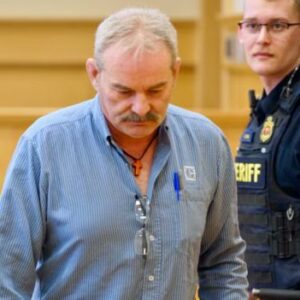
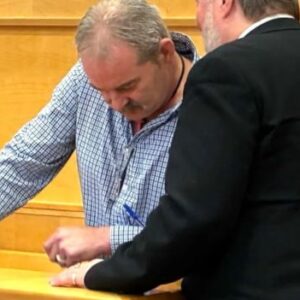
Accused of killing Jennifer Hillier-Penney in 2016, Dean Penney begins his testimony at his first-degree murder trial

Finding out his estranged wife, Jennifer Hillier-Penney, was missing came as a “pretty big shock,” Dean Penney said as he began his testimony in his first-degree murder trial on Thursday, May 7.
As Penney sat in the witness stand in the Supreme Court of Newfoundland and Labrador in Corner Brook, there was a distinct feeling of heaviness and tension in the room.
Penney is accused of killing Hillier-Penney in the home they once shared in St. Anthony on Nov. 30, 2016.
He confessed to doing so to a fictitious crime boss in 2023 in an elaborate undercover investigation technique used by the RCMP known as a Mr. Big operation.
His defence counsel, Mark Gruchy and Jeff Brace, are arguing that the confession was not true and that there is an “alternate suspect” who is responsible for Hillier-Penney disappearance and death.

Penney was to begin his testimony on Thursday morning, but the court had to adjourn until after lunch because of an issue with the recording equipment.
“Today’s a bit of an important day,” Justice Vikas Khaladkar said as he explained the delay to the jury.
When the court resumed, Penney swore on the Bible to tell the truth in his testimony, as the gallery — filled with Hillier-Penney’s family and supporters, at least a dozen RCMP officers, the media and a few curious members of the public — listened intently.
Gruchy started by questioning Penney about where he grew up, what his life was like in St. Anthony and the work he did.
Penney, 52, calmly and in a low voice answered the questions, explaining that he grew up in Great Brehat, about 10 kilometres from St. Anthony.
He moved to St. Anthony with Hillier-Penney and their two children, Deana Penney and Marina Goodyear, around 2011 or 2012. Their house on Husky Drive, from where Hillier-Penney went missing, was newly constructed then.
Penney said he worked primarily in the offshore fishery until a downturn in the fishery, and then made the switch to the inshore fishery. He also worked in the ice plant of his mother’s offloading facility.
He said he did well financially and described life as being “pretty good” until the downturn in the fishery, when his income dropped from $70,000 a year to about $25,000. He’d cut and sell wood and worked as a welder or carpenter, whatever work he could get, to earn money.
They met when he was 22, and she was just 17.
There’s been evidence presented in the trial that Hillier-Penney wanted a divorce, and text messages between the two show him badgering her to reconcile.
He said their relationship changed in the few months before her disappearance, but up until then, they “got along as good as anybody.”
He said he gave her whatever she asked for.
“I probably had her and the kids spoiled,” he said.
The disintegration of their relationship was hard, he told the court, adding, “I loved her very much.”
He said he didn’t have any problems with her and didn’t think she had any with him.

Going to the house on Husky Drive
Before her disappearance, Hillier-Penney was staying with her father in St. Lunaire-Griquet.
“I worked hard on trying to put things back together,” said Penney, and added he guessed they just drifted apart.
He said Hillier-Penney would be at the Husky Drive home whenever he wasn’t. Basically, whenever he couldn’t be there with their youngest daughter, Deana, who still lived at home at the time.
Hillier-Penney was at the home on Nov. 30, 2016, to look after their daughter while Penney was away duck hunting at his cabin in Hare Bay.
He said the day started like any other. Bad weather continued to prevent him from doing much hunting.
The cabin is about 55 minutes from St. Anthony, and Penney said he drove into town that evening around 6:30 p.m., got a coffee, then just drove around.
Asked by Gruchy if he went to his house, Penney said “no.”
Around 10:30 p.m., he decided to call it a night. After listening to the marine forecast, which predicted better weather for hunting the next day, he decided to go to the house to get more decoys.
That’s something he told police about in statements he gave after Hillier-Penney disappeared.
Four years later, during the undercover investigation, he told the fake crime boss that he had gone to the house earlier in the night, sometime after Hillier-Penney arrived after having supper with her sister, and that the two had an altercation. In a recording from his talk with the crime boss played in court, he told him that Hillier-Penney came at him and he pushed her away. He said she tripped and fell down the stairs in the garage, striking her head on a gun safe, and that’s how she died. He later added that he hit her in the head at least three times with a mallet to make sure she was dead.
He said he called Deana around 10:30 p.m. and told her he was coming to the house to get some decoys from the garage and would be there within a few minutes.
He’d told the crime boss that he’d cleaned up the garage after Hillier-Penney died and then went back to get her body, which had been wrapped in a Sea-Doo cover. He’d earlier said he’d put it in the decoy bag.
In his testimony Thursday, Penney said Deana came out to the garage when he got there. He said he told her he wasn’t sure where her mother was, and that Deana said Hillier-Penney had told her she had a headache and was going to lie down.
He said he picked up the decoys and took some broken ones out of the bag before zipping it up. He gave his daughter a kiss and left.
He said he noticed his vehicle was low on gas and pulled into the Irving on Main Street to get gas before driving to the cabin. He got there around 11:45 p.m.
CCTV surveillance video from the Irving has shown him being there just before the station closed at 11 p.m.
Penney testified Thursday that he slept at the cabin that night.
He told the crime boss, however, that once he got to the cabin, he put Hillier-Penney’s body in his boat and dumped it into Hare Bay.

Around 7 a.m. on Dec. 1, 2016, Penney testified that he received a call from his mother, Ruby Penney, who died in 2021, asking if he’d seen Hillier-Penney.
He assumed she was home, but Ruby said she was at the house, and Hillier-Penney wasn’t there.
He said he drove back to St. Anthony, and Hillier-Penney’s brother, Glen Hillier, was called, as well as an RCMP officer who lived next door.
When the officer arrived, they went through where she might be and who she might be with.
“Nobody seen anything, nobody heard anything,” he said.
“We didn’t know what to do.”
He said he tried to be accommodating with the police and gave a lot of statements.
Hillier-Penney was never found. As the years progressed, Penney said, there were no leads, but the finger was “getting pointed.”
Asked what he meant, Penney replied: “They were pointing the finger at me.”
He recalled being told by an RCMP officer that statistics show that 95 per cent of the time in cases like this, it’s the spouse who is responsible.
He took that to mean that he was their main suspect.
“A bit of a shock. I was good to her. I was good to the family,” he told the court.
He said it didn’t matter what they were going through during their separation.
“She was still my wife,” he said.

Things got worse
Penney also said that as time went on, things got worse for him.
He said Deana was pretty good, but his older daughter Marina had a lot of outside people in her ear.
In the community, he added, things were bad, and he knew everyone was talking about what had happened to Hillier-Penney.
“It’s a gossip town anyway,” he said.
It got to a point where he started to keep to himself. He said he did what he had to survive, and it impacted his mental health.
“I got into cocaine pretty hard,” he said.
The drugs were expensive, and he had a lot of financial issues.
“I was basically a mess,” he said.

Mr. Big operation
The RCMP launched its Mr. Big operation in September 2019 when an undercover officer, identified in court as UC Vic, was sent to St. Anthony to befriend Penney.
UC Vic introduced himself as a friend of one of Penney’s good friends and asked if Penney could point him in the right direction or take him on a hunting trip.
Penney said he thought UC Vic was a pretty good guy.
“He seemed genuine,” he said.
Penney was paid for renting his cabin to UC Vic. He was still having financial troubles, and a few times after that, he said he asked if there was anything they needed help with.
He got closer to UC Vic, talking on the phone two or three times a week, and when they were working, he was with him every day.
He called him “a very good friend,” and later said, “he was one of my best friends.” There were “bro hugs” and gifts.
“He was no different than family,” said Penney.
Work was welcomed
After his mother died, Penney’s financial situation got worse.
He no longer worked at the offloading facility and was having trouble keeping up with the bills, the mortgage on his home, and the upkeep of the home he inherited from his mother. It was the family home, and he said he couldn’t sell it.
He said UC Vic helped him personally and financially. The odd jobs he got made a difference in his finances.
Penney didn’t know it, but his conversations with UC Vic were being recorded, and in one on Dec. 3, 2020, he brought up Hillier-Penney.
He said he probably wanted him to know how he was feeling at that time and that he was stressed because people thought he was involved.
Gruchy pointed to a part in the transcript of that recording where Penney questioned what he could do to prove he didn’t do anything to his estranged wife.
Gruchy asked why he was concerned about proving it.
“I was just tired of people blaming me for something I didn’t do,” Penney responded.
Penney said people in the community were violent towards him, and the RCMP told him there had been death threats. A bullet had come through the back wall of his house.
He said to UC Vic that the only way to prove his innocence was to find someone else who had something to do with it.
Penney said the reason he said that was that there was nobody else being looked at, and he felt like he had to prove his innocence.

Not violent
Gruchy said Penney told UC Vic that he’d never be able to hurt Hillier-Penney and described her as his “sun” and “sunshine.”
Gruchy said there has also been evidence heard that, over time, he let UC Vic know he was opposed to violence towards women.
Penney said he wanted to establish that he would defend himself if needed, but he wasn’t violent towards women.
More work for the organization
Penney said not all the work he did for the organization was criminal in nature, but he did start to see there was more to the organization than just being a transportation and repo company.
At one point, he was asked to help investigate another member who was doing some “sketchy” things.
The man, UC Jay, had been vouched for by another member, UC Tracy. Penney said he understood that if you vouched for someone, you were on the line for that person and subject to being fired, or maybe worse than that. UC Jay’s actions were making UC Tracy look bad.
UC Vic told Penney it would break his heart if he did to him what UC Jay did to UC Tracy.
Penney said that it was a little distressing to hear, but said it felt good that he thought of him that way. He said it was a serious thing.
Asked what he meant by “something worse happening,” Penney said he assumed the more you knew, the worse it would be, and the consequences would be greater.
He said you could end up being put away or made away with.
Gruchy opted to end his questioning for the day at that point.
Another RCMP officer testifies
The problem with the court’s recording system was not detected until after RCMP Sgt. David Cooke testified in the morning.
Cooke was working in major crime at the time Hillier-Penney disappeared and was the primary investigator on the file from December 2016 to mid-2018.
Cooke is the officer who spoke with Morley Hillier in December 2016.
Morley Hillier, who is of no relation to Hillier-Penney, testified on April 7 about a statement he gave to the police after Hillier-Penney went missing. The statement was focused on a conversation he had with Penney at the Scotiabank in St. Anthony around Nov. 7, 2016, a few weeks before she disappeared.
Morley Hillier said Penney told him that he and Hillier-Penney had split up and that she was going to disappear. Morley Hillier said Penney also said that the Hillier family was not going to get anything that he worked for.
Cooke, who had his notes from that day with him, said he received a message from the RCMP’s communications centre that Morley Hillier had information with respect to the investigation.
He called Morley Hillier at 11:44 a.m. on Dec. 10, 2016, but he was not able to talk, and told Cooke to call him after lunch.
Cooke called him at 12:40 p.m. Morley Hillier told Cooke he was living in Clarenville and was from St. Anthony and had lived in Clarenville for a few months.
Morley Hillier told Cooke about his encounter with Penney and said it occurred in Clarenville.
Morley Hillier then told him that Penney had said Hillier-Penney had moved in with her father, and she would disappear and not take everything he had.
When Morley Hillier originally testified, Gruchy questioned him about telling the police that the interaction with Penney occurred in Clarenville and not St. Anthony.
Morley Hillier replied that he guessed the officer had written it down wrong.
On cross-examination, Crown attorney Kate Ashton asked Cooke if it was possible that he wrote down the wrong location because Morley Hillier had been talking about the two locations.
“It could be possible,” said Cooke.
On redirect, Gruchy asked him if, when writing notes, it’s his understanding that they are accurate as written.
“That is correct,” said Cooke

Juror excused
Just before the trial broke for the day, Khaladkar said he had received an application from one of the 14 jurors asking to be excused due to having another commitment that was to start on Friday, May 8.
The trial had been scheduled to be completed on April 30, but several delays have pushed it into May.
That juror was thanked for their service and excused.
One of the two jurors who is currently sitting as an alternate will move into the vacant spot.
Before the jury begins deliberations, the jury will be reduced from 13 to 12, as only 12 can deliberate.
Penney will continue his testimony when the trial resumes on Friday, May 8.
With Friday only scheduled for half a day, it’s unlikely that the Crown will cross-examine Penney until next week.